


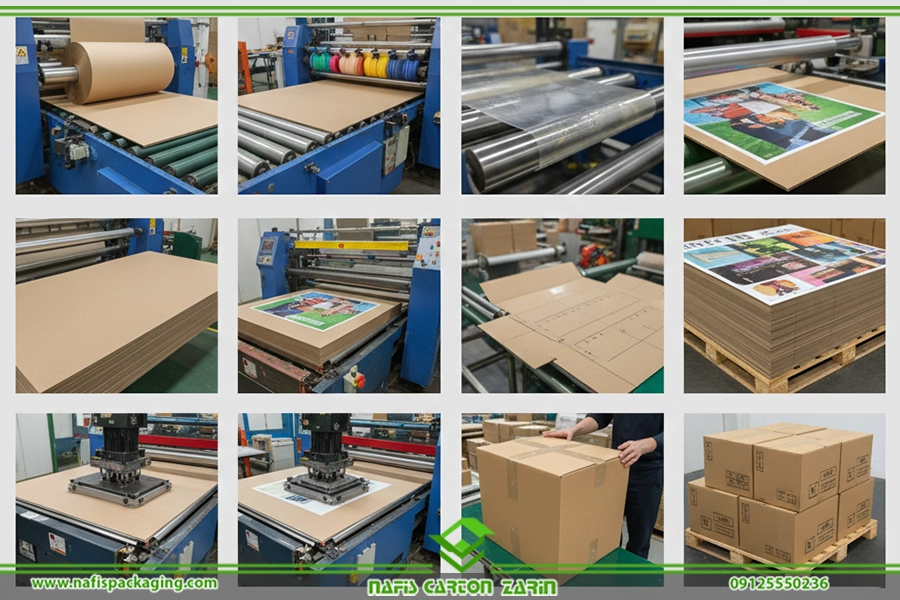
The cardboard production process from zero to one hundred; from sheeting to printing and die-cutting
Cardboard is one of the most widely used packaging materials across various industries, and its production is a precise, multi-step process. To understand the entire cardboard production process—from paper sheet manufacturing to printing and die-cutting—it is essential to examine each stage carefully. This 2,000-word, comprehensive, SEO-optimized article will guide you through the complete steps of cardboard production, the equipment used, and important considerations at each stage.
1. Preparation of raw materials
The first step in cardboard production is to prepare raw materials. The main materials include:
- Pulp (mechanical or chemical)
- Recycled paper
- glue
- Color and ink
Important points:
- The quality of paper pulp has a direct impact on the final strength of the cardboard.
- Using recycled paper is more economical, but its quality must be controlled.
2. Sheet metal fabrication
Definition:
Sheeting is the process by which paper pulp is converted into thick, durable sheets that will be the main basis of cardboard.
Steps:
- The pulp is transferred to the mixer.
- The ingredients are mixed and diluted with water.
- They are transferred to the Fourdrinier sheet forming machine.
- Excess water is removed and the sheet is dried.
Key points:
- The thickness of the sheets should be uniform.
- The quality of the sheet surface is important for printing and lamination.
3. Layering and structure of the carton
Cartons are usually divided into two types: three-layer and five-layer.
Three layers:
- A flute layer between two smooth layers
- Suitable for light products
Five layers:
- Two flute layers and three smooth layers
- Suitable for heavy and export goods
Important points:
- The layers are joined together with glue.
- The uniformity of the flutes has a direct impact on the strength of the carton.
4. Printing stage
Types of printing:
- Flexo printing: economical, suitable for simple boxes
- Offset printing: high quality, suitable for brand packaging
- Digital printing: for small runs and diverse designs
Key points:
- Print quality depends on the smoothness of the sheet surface.
- The color and ink must be resistant and uniform.
5. Lamination (optional)
Lamination protects the print and increases its strength.
- Matte or glossy laminate
- Prevent moisture penetration and scratches
Advantages:
- Extending the shelf life of packaging
- Elegant and professional appearance
- Better resistance to transportation
6. Cutting and die cutting
Die cutting is the process where sheets are cut into final shapes based on a template.
Die-cutting equipment:
- metal mold
- press machine
- Automatic or semi-automatic devices
Important points:
- The precision of the mold allows cartons to be assembled without errors.
- Special shapes, grooves, and doors can be designed.
7. Folding and assembly
After die-cutting, the cartons are folded and, if needed, assembled into a ready-made box.
Steps:
- Fold specified lines
- Gluing the edges
- Installing partitions or bumpers (if needed)
Important points:
- The quality of the glue and the precision in folding make the cardboard resistant.
- This step affects the final quality and safety of the product.
8. Quality control
Criteria:
- Sheet thickness and uniformity
- Strength and compressive strength
- Printing and lamination quality
- Cutting and die-cutting accuracy
- Quality of glue and assembly
Methods:
- Manual and pressure testing
- Appearance review
- Laboratory tests for export packaging
9. Packaging and preparation for shipping
Cartons produced after quality control:
- They are placed on pallets.
- They are placed in a protective bag or plastic.
- They are ready for transport to the customer or store.
10. Practical tips for producers
- Choosing quality raw materials
- Using up-to-date and accurate equipment
- Performing quality control at every stage
- Training of employees and operators
- Pay attention to printing, lamination, and die-cutting for professional packaging
Conclusion
The process of producing cartons from scratch includes the following steps: raw material preparation, sheeting, layering, printing, laminating, die-cutting, assembly, and quality control. Each step affects the strength, appearance, and final performance of the carton. By following technical tips and using the right equipment, high-quality, durable, and attractive cartons can be produced that are suitable for transportation and stores.