


How to identify the quality of packaging cardboard?
Introduction
Identifying the quality of packaging cardboard is one of the most important steps in selecting reliable, durable, and suitable packaging for transportation or storage. Many issues during shipping—from crushing to tearing—occur due to choosing the wrong cardboard.
In this guide, developed around the keyword “How to identify the quality of packaging cardboard?”, we comprehensively and practically cover all the essential points for evaluating cardboard quality.
Why is cardboard quality important?
The packaging carton is the first barrier protecting the product from pressure, moisture, impact, and environmental damage. If the quality of the carton is poor:
- The product is damaged during transportation.
- The likelihood of orders being returned increases.
- Brand credibility decreases.
- Warehousing and packaging costs increase.
On the other hand, choosing high-quality cardboard will:
- Product safety is guaranteed.
- Improve customer experience.
- Reduce the final cost of transportation.
- The brand appears more professional.
Main methods for identifying the quality of packaging cardboard
Below, we will mention 10 basic and completely practical criteria that anyone—even without specialized knowledge—can use to evaluate the quality of cardboard.
1. Check the number of layers (three or five layers)
The first indication of the quality of cardboard is the number of layers it has. Cardboard is usually produced in two types:
- Three-layer: Suitable for light to medium-heavy products (clothing, food, cosmetics)
- Five-layer: Suitable for heavier or sensitive products (household appliances, industrial parts, glass, etc.)
How to check layers?
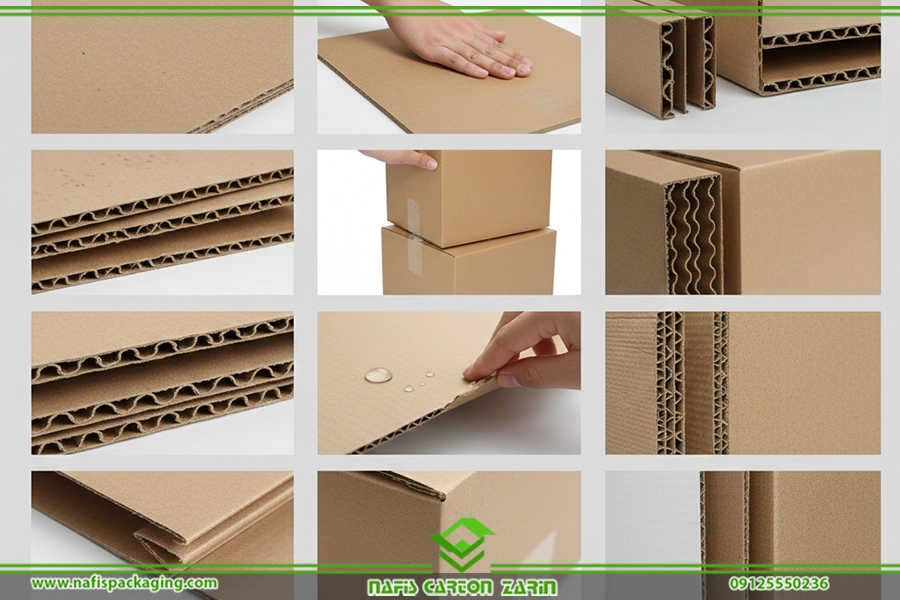
Examine the edge of the carton from the side; its structure should include:
- One layer of smooth inner paper
- An outer layer of smooth paper
- One layer of flute (corrugated) in a three-layer carton
- Two layers of flute in a five-layer carton
The more prominent and regular the flutes, the more resistant they are.
2. Check the flute type (corrugated)
The type of flute plays an important role in compressive strength and impact resistance:
- B flute: more durable, suitable for transportation
- C flute: lighter, suitable for packaging consumer goods
- E-flute: For delicate and printed packaging
- BC or EB combination: in very durable five-layer cartons
If you don’t know what a flute is, look at a cardboard box cut in half; the waves inside indicate the type of flute.
3. Compressive strength test (by hand)
For a quick check, you can assess the strength of the cardboard by squeezing its sides.
If the carton:
- Assembled very quickly → Poor quality
- Withstood controlled pressure → Average quality
- Hard to assemble and retains its structure → High quality
This test is especially suitable for checking large cartons.
4. The quality of the paper used
High-quality cartons are usually made from stronger papers such as kraft.
Signs of quality paper:
- uniform color
- Puffiness-free surface
- No excess fibers or lint
- Suitable paper weight (high grammage)
What are the characteristics of low-quality paper?
- They tear easily.
- They crack when folded.
- They have an uneven or dull color.
5. Checking the carton joints and adhesives
One of the clearest signs of quality is the tight connection of the walls.
Sensitive areas:
- Lipstick place
- cardboard floor
- the doors
If the glue is dry, thin, or uneven, the carton will open during shipping.
6. Humidity and water resistance test
The packaging carton should not bend with even the slightest humidity.
Simple test:
Tap the corner of the cardboard with your finger:
- If it softens immediately → poor quality
- If it changes slightly → acceptable quality
- If it remains almost constant → high quality (kraft paper)
Moisture-resistant cartons are essential for the food, fruit, pharmaceutical, and export industries.
7. Checking the printing and coating of the carton
Clear and uniform printing is one of the signs of good quality in cardboard production.
Points to consider:
- Quality of printing lines
- Color uniformity
- No color shedding
- No shading
Printed cartons, especially flexo and offset printing, reflect precision manufacturing and the use of better raw materials.
8. Measuring the thickness of the cardboard
The thickness of the cardboard is one of the most important factors in determining its strength. Typical thickness:
- Three-layer cardboard: 3 to 4 mm
- Five-layer cardboard: 5 to 7 mm
Five-layer cardboard: 5 to 7 mm
9. Real test by placing the product inside the carton
There is no better test than a practical exam.
Simple method:
- Place the actual item inside the carton.
- Shake the carton.
- Drop from a height of 30 cm.
If the carton:
- Crushed → poor quality
- Changed a little and remained stable → Average quality
- No damage → Excellent quality
10. Inquiry about the type and weight of paper from the manufacturer
If you are buying from a manufacturer or seller, ask the following questions:
- What is the weight of the layers?
- What type of flute is it?
- Is it kraft paper or recycled?
- Have resistance tests been performed?
A reputable manufacturer will always provide information without concealment.
Factors affecting the final quality of packaging cardboard
The quality of cardboard does not depend only on the paper or layers; other factors are also important:
1. Type of production machine
Modern machines have more uniform output and more precise cuts.
2. Quality of glue or staples
Poor quality glue will open the carton even with little pressure.
3. Production standards
Reputable manufacturers use the BCT, ECT, and FCT standards to measure carton strength.
4. Press and hold
The precise line prevents the carton from tearing during assembly.
What cartons are suitable for what products?
To make the right choice and determine the quality you need, you need to know which type of cardboard is best suited for your product.
Suitable carton for light products:
- Three-layer with C flute
- Monochrome or plain printing
Semi-heavy products:
- Three-layer durable or five-layer lightweight
- B or BC flute
Heavy products:
- Five-ply with BC flute
- Kraft paper
- Strong adhesive
Highly sensitive products:
- Die-cut cardboard with a durable structure
- Accurate printing
- Reinforced edges
Common mistakes in choosing packaging cartons
Many buyers purchase poor quality cardboard due to some simple mistakes.
Mistake #1: Not paying attention to the weight of the product
Many only look at the size of the carton, not its weight-bearing capacity.
Mistake 2: Buying cheap cardboard
Low price usually means using low quality paper.
Mistake 3: Ordering without testing the sample
Always test samples before purchasing in bulk.
7 Signs of a Really High-Quality Cardboard Box
- Uniform color and lack of dullness of the surface
- No irregular waves or crushing
- Suitable thickness in all areas
- Sharp, blur-free printing
- Resistance to bending and pressure
- Clean and standard glue stick
- Using high-quality kraft paper
Summary: How to identify the quality of packaging cardboard?
To determine the quality of packaging cardboard, you need to carefully examine a set of characteristics—from layers and flute type to strength, adhesive, thickness, grammage, and printing. You can’t make a decision based on appearance alone; you also need to perform simple tests such as pressure, humidity, and placing the product inside the carton.
Choosing a quality carton not only ensures product safety, but also saves costs, reduces returns, and increases customer satisfaction.